
Selvol PVOH 425: Superior Oil Resistance and Ink Holdout for Paper & Paperboard
Achieve exceptional barrier properties without the viscosity limits of starch.
Papermakers face a trade-off. Starch is cost-effective but fails strict oil and grease resistance (OGR) specs due to viscosity limits. Selvol polyvinyl alcohol (PVOH/PVA) 425 from SEKISUI Specialty Chemicals bridges the gap in paper and paperboard applications.
This high-performance Selvol™ PVOH grade creates a tighter film than starch or fully hydrolyzed grades. It allows mills to achieve superior Vanceometer ratings, even at low add-on levels.
Whether you’re optimizing food packaging for OGR or improving surface density for barriers, Selvol PVOH 425 delivers proven holdout control.
Benefits of Selvol PVOH 425 for Paper and Paperboard
SEKISUI developed Selvol PVOH 425 to outperform standard surface sizing agents in critical barrier applications. These are its key characteristics for paper and paperboard:
- Maximized oil and grease resistance (OGR). It reduces porosity to block oils, greases and solvents, confirmed via Mazola and TAPPI Turpentine tests.
- Intermediate hydrolysis advantage. Selvol 425 delivers tight film formation and greater substrate adhesion compared to fully hydrolyzed grades.
- Formulation efficiency. It’s effective as a stand-alone size or in starch blends, boosting performance without replacing your system.
- Ink and solvent holdout. Selvol 425 controls ink permeation and feathering on uncoated printing and writing papers.
Why Selvol PVOH 425 Outperforms Starch
Viscosity limits the amount of starch you can apply to a sheet. Selvol PVOH 425 bypasses this limitation.
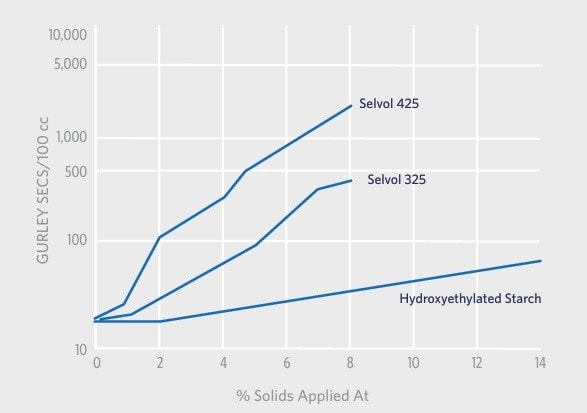
Labs confirm Selvol PVOH 425 reduces air porosity better than starch. This holds true even when you apply starch at higher solids levels. It forms a tight continuous film, preventing pinholes that allow oil and solvent penetration.
Selvol PVOH 425 has an intermediate hydrolysis level (95.5%–96.5%), optimal for surface sizing. Tests show significantly lower porosity than super-hydrolyzed and fully hydrolyzed grades.
Improving OGR and Chemical Efficiency With PVOH
Selvol PVOH 425 does more than just block oil; it enhances your entire coating formulation’s performance:
- Fluorochemical synergy. It acts as a highly effective carrier, achieving high 3M Kit ratings while using less expensive fluorochemicals.
- Broad barrier protection. It creates robust barriers against grease as well as waxes and aggressive organic solvents.
- Validated holdout specs. Selvol PVOH 425 consistently meets rigid Vanceometer, TAPPI Turpentine and K&N ink holdout specifications.
- Surface strength. It upgrades starch formulations to improve surface strength and control dusting on the size press.
Test Data: Porosity Reduction and OGR
See how Selvol PVOH 425 compares to industry standards in head-to-head testing.
Air Porosity Reduction (Gurley Seconds)
The top line (Selvol 425) shows a dramatic increase in Gurley seconds. This indicates a tighter, less porous sheet. Starch remains flat, failing to reduce porosity.
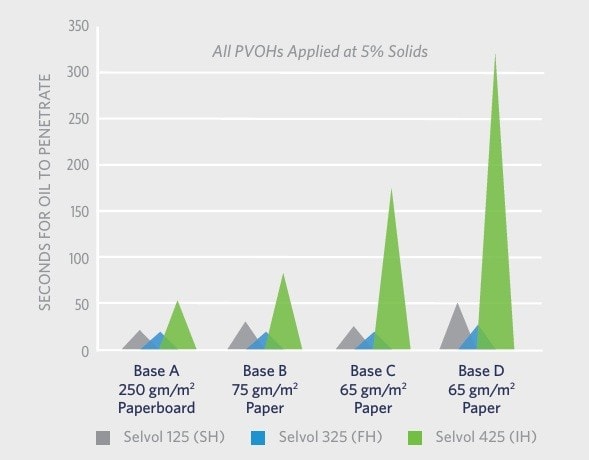
OGR Performance (Mazola Drop Test)
Selvol PVOH 425 (tallest cones) blocked oil penetration longest. This result held across four distinct substrates.
Commercial Case Studies: OGR Improvement
Selvol PVOH 425 is already helping mills meet previously unreachable specifications. A recycled paperboard mill and a solid bleached paperboard mill achieved innovative solutions to common challenges.
Recycled Paperboard Mill
- Challenge. Starch alone missed oil and grease resistance specs.
- Solution. The mill switched to a 70/30 starch/Selvol formulation.
- Result. It achieved a 20-unit Vanceometer improvement.
Solid Bleached Paperboard Mill
- Challenge. The product required high-spec barrier properties unobtainable with starch.
- Solution. The mill implemented a 60/40 starch/Selvol formulation.
- Result. It achieved an 80 Vanceometer specification.
Technical Comparison: Starch vs. Selvol PVOH 425
Here’s why using Selvol PVOH 425 in your paper applications makes technical sense.
| Feature | Starch Only | Selvol PVOH 425 | Benefit |
|---|---|---|---|
| Barrier integrity | Poor (discontinuous film) | Excellent (continuous film) | Total barrier to organic solvents |
| Porosity | High | Extremely low | Improves Vanceometer rating |
| Solids required | High (>10%) | Low (<5%) | More efficient material usage |
| OGR | Low | Extremely high | Ideal for OGR packaging |
Commercial Specifications
Selvol PVOH 425 meets precise viscosity and hydrolysis standards for consistent runnability.
| Grade | % of Hydrolysis | Viscosity* (cPs) | Application Focus |
|---|---|---|---|
| Selvol PVOH 425 | 95.5–96.5 (intermediate) | 27–31 | Maximized OGR and barrier properties |
| Selvol PVOH 325 | 98.0–98.8 (fully) | 28–32 | General purpose |
| Selvol PVOH 125 | 99.3+ (super) | 28–32 | High tensile strength |
Note. Viscosity is based on a 4% aqueous solution at 20°C.
Selvol PVOH 125 and 325 aren’t limited to OGR applications. The same super and fully hydrolyzed grades are also the standard recommendation for silicone-coated release base paper.
Contact SEKISUI for Selvol PVOH 425
Selvol PVOH 425 is ideally suited to paper and paperboard formulations, where OGR and ink holdout are crucial. It can support food-grade paper and paperboard packaging and offers clear performance advantages over starch.
Contact SEKISUI for more information about Selvol PVOH grades, or request samples now. Premade solutions are available for ease of preparation.
Reach out to the SEKISUI Technical Service Team. They’ll assist with formulation ratios and offer expert customer support.