
Selvol PVOH: Proven Barrier Coatings for Silicone-Coated Release Base Paper
Seal the sheet. Keep your silicone where it works.
Silicone coatings are only effective when they stay on the surface. Whether you’re applying a solvent-based, 100% solids or emulsion silicone system, penetration into the base sheet wastes expensive coating and undermines release performance.
A surface-applied barrier coat is the standard solution. Selvol™ polyvinyl alcohol (PVOH) from SEKISUI Specialty Chemicals is among the best available for this application.
Selvol PVOH grades are trusted components in paper applications, from the size press to the coater.
Why Selvol PVOH Works as a Barrier Coat for Silicone Coatings
Selvol PVOH forms a tight, continuous film that closes sheet pores, sharply reduces porosity and resists organic solvents and oils. Several properties make it particularly well-suited to silicone coating applications:
- Bonds to both cellulose and silicone through hydroxyl hydrogen bonding
- Is chemically inert to the catalyst systems used in silicone curing
- Dries as a transparent film
For silicone-coated release base paper, SEKISUI recommends super and fully hydrolyzed grades. They help base sheets achieve the Gurley density, Cobb-Unger holdout and Cobb water resistance that glassine and supercalendered kraft (SCK) papers demand.
Key Performance Advantages
Common water-soluble surface size alternatives include ethylated corn starch (ECS), carboxymethyl cellulose (CMC) and hydroxyethyl cellulose (HEC).
Here’s how Selvol PVOH outperforms them where it counts most:
- Porosity reduction and Gurley density improvement. Selvol PVOH closes sheet pores more effectively than ECS, CMC and HEC. It produces a denser, less permeable base sheet, which is the foundation of reliable silicone holdout.
- Greater silicone holdout (Cobb-Unger). Its oil and solvent barrier properties give it a structural advantage over CMC and HEC, which are hydrophilic but weaker film formers.
- Water resistance and crosslinkability. Water resistance is comparable to ECS and significantly better than CMC and HEC. Selvol PVOH also accepts glyoxal crosslinking, providing a reliable path to further improvement for demanding glassine applications.
- Transparency for labeling applications. Selvol PVOH dries as a clear film, preserving the sheet transparency that high-speed labeling lines require for reliable photocell detection without adding a visible coating layer.
- Silicone cure compatibility. Inert to the metal catalyst systems used in silicone curing, Selvol PVOH won’t compromise release performance downstream.
How Selvol PVOH Compares to Other Surface Sizers
Lab testing shows Selvol PVOH 125 outperforming standard water-soluble binders across every critical measurement for silicone-release base paper.
Here’s how the numbers compare.
Gurley Density
Selvol PVOH 125 achieves a Gurley density of 44,663 sec/100cc after supercalendering. That’s nearly three times that of CMC (16,191) and HEC (16,190) and more than five times that of ECS (8,362).
The untreated base sheet measures just 1,055 sec/100cc. Higher Gurley density means a tighter, less porous sheet and better conditions for silicone holdout.
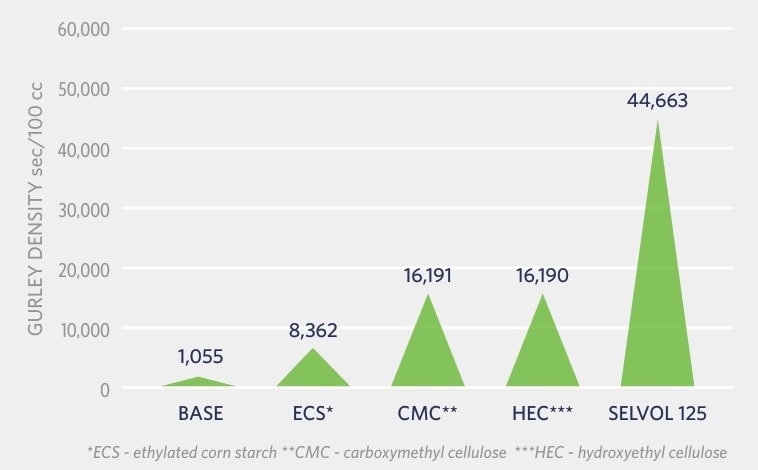
Gurley density after supercalendering: Selvol PVOH 125 vs. ECS, CMC and HEC.
Cobb-Unger Absorption
In the Cobb-Unger test, Selvol PVOH 125 absorbs just 0.64 g/m², the lowest result among tested binder types.
ECS absorbs 3.28 g/m², HEC 2.83 g/m² and CMC 1.36 g/m². The untreated base sheet absorbs 5.64 g/m². Lower absorption means better silicone holdout.
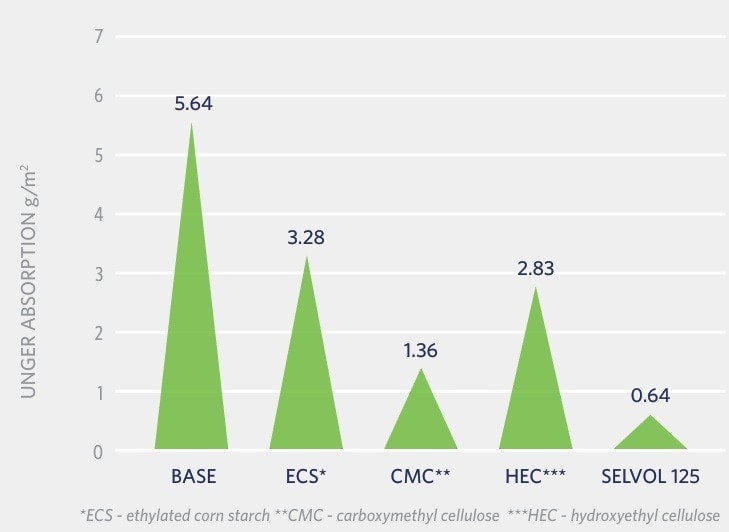
Cobb-Unger absorption after supercalendering: Selvol PVOH 125 vs. ECS, CMC and HEC.
Cobb Water Absorption
Selvol PVOH 125 delivers a Cobb water absorption of 20.24 g/m². This is on par with ECS (20.84 g/m²) and significantly better than CMC (27.20 g/m²) and HEC (25.94 g/m²).
Formulators can further improve water resistance with glyoxal crosslinking.
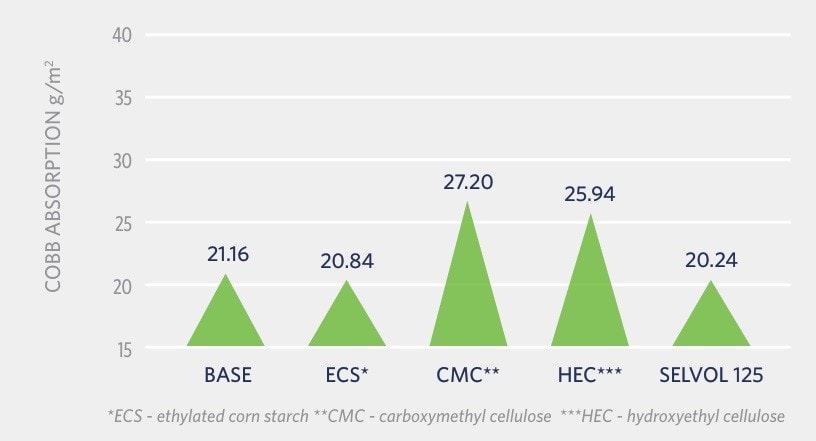
Cobb water absorption: Selvol PVOH 125 vs. ECS, CMC and HEC.
What Selvol PVOH Grades Work Best for Silicone Base Sheets
At SEKISUI, we recommend super hydrolyzed (99.3+% hydrolysis) and fully hydrolyzed (98.0–98.8% hydrolysis) grades for all silicone coating types. The right grade for your process depends on the viscosity requirements of your application equipment.
| Grade | Hydrolysis, % | 4% Solution Viscosity (cPs) |
|---|---|---|
| Selvol PVOH 125 | 99.3+ | 28.0–32.0 |
| Selvol PVOH 325 | 98.0–98.8 | 28.0–32.0 |
| Selvol PVOH 310 | 98.0–98.8 | 9.0–11.0 |
| Selvol PVOH 107 | 98.0–98.8 | 5.5–6.5 |
Note. Viscosity is measured as a 4% aqueous solution at 20°C.
Glassine and SCK Liner Requirements
Selvol PVOH meets the holdout and density requirements for the two most common release liner types.
The following are general specification targets for glassine and SCK papers.
| Property | Glassine | SCK |
|---|---|---|
| Gurley density (sec./100 cc) | > 20,000 | > 12,500 |
| Cobb-Unger absorption | 0.5–0.9 g/m² absorbed | 0.7–1.0 g/m² absorbed |
| Cobb absorption | < 25 g/m² | < 25 g/m² |
| Transparency | 45–55% | 40-44% |
How To Formulate and Apply Selvol PVOH for Release Base Papers
Selvol PVOH is straightforward to formulate and apply on standard paper machine equipment:
- Crosslinking for enhanced water resistance. Add glyoxal at 2–6% dry on dry PVOH to improve water resistance and prevent picking of the PVOH surface size on supercalender rolls. This is particularly important for glassine papers, which manufacturers usually remoisturize to 15–20% before densification on the supercalender.
- Coat weight. A PVOH coat weight of 0.5 to 2.5 g/m² is typically sufficient to achieve the holdout properties needed for good silicone performance.
- Application methods. Apply Selvol PVOH via rod application, metering size press or conventional size press. All three methods keep the wet PVOH layer on the sheet surface, where the dried film provides the silicone barrier.
Contact SEKISUI for Selvol PVOH
Selvol PVOH is a proven barrier coat solution for silicone-coated release base paper. It delivers the Gurley density, silicone holdout and water resistance that glassine and SCK papers require.
Contact SEKISUI for more information about Selvol PVOH grades, or request samples today. Premade solutions are available for ease of preparation.
Reach out to the SEKISUI Technical Service Team. They’ll assist with grade selection, formulation ratios and application support.