

Polyvinyl Alcohol for 3D Printing
3D printing holds promise for industries ranging from automotive to healthcare, and polyvinyl alcohol is fundamental to high-performance formulations.
Polyvinyl alcohol (PVOH/PVA), exemplified in Selvol™ PVOH from SEKISUI Specialty Chemicals, has become a mainstay of modern 3D printing. Formulators primarily use it to print water-soluble support structures for complex geometries.
Fused deposition modeling (FDM) is the layer-by-layer 3D printing process that most desktop and industrial printers use. During FDM, a dual-extrusion printer runs two filaments at once: one for the finished part and PVOH for a temporary support that dissolves afterward.
As additive manufacturing expands into aerospace, healthcare and consumer goods, PVOH’s role keeps growing too.
How PVOH Works in 3D Printing Support Structures
The FDM 3D printing process works well until a design calls for overhangs, internal channels or undercuts. These features need temporary scaffolding during the print. That scaffolding is the support structure, and it has to come off cleanly afterward without damaging the finished part.
PVOH solves this problem through its basic chemistry. It dissolves in water, so a dual-extrusion printer can lay down a soluble PVOH support alongside a standard build material. Submerging the finished print in water completely removes the support without cutting, scraping or sanding.
This water solubility traces back to PVOH’s core structure. Its degree of hydrolysis and molecular weight per grade determine how it performs:
- How readily it dissolves
- How well it adheres to the primary build material
- How it acts at extrusion temperature
As a formulator, you can tune these variables when you build a support material for a unique printer and build material combination.
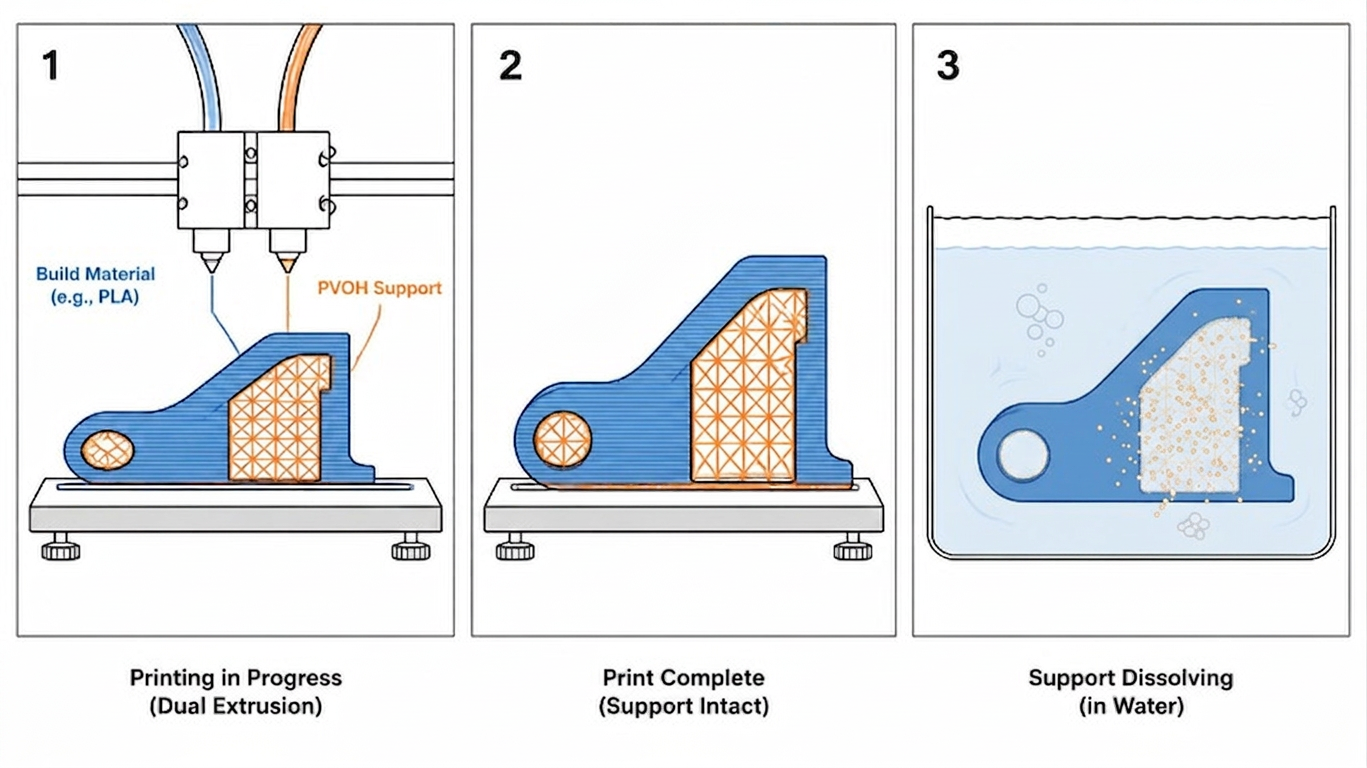
A three-panel graphic shows the FDM printing process with PVOH support material.
PVOH vs. Other Soluble Support Materials for 3D Printing
PVOH is one of several soluble support options. High-impact polystyrene (HIPS), butenediol vinyl alcohol copolymer (BVOH) and hydroxypropyl methylcellulose (HPMC) appear in formulas. Here’s how PVOH stacks up against them.
| Support Material | Dissolves In | Common Material Build Pairing | Key Tradeoff |
|---|---|---|---|
| PVOH/PVA | Water | Polylactic acid (PLA), polyethylene terephthalate glycol-modified (PETG), nylon blends | Hygroscopic; needs dry storage |
| BVOH | Water | PETG, thermoplastic polyurethane (TPU), broad material range | Higher material cost |
| HIPS | D-limonene | Acrylonitrile butadiene styrene (ABS) | Requires solvent, not water-soluble |
| HMPC | Water | Not yet standardized for a specific build material | Limited FDM use; more prominent in pharmaceutical/research-grade printing |
PVOH’s Advantages Over Alternatives
PVOH remains the standard choice for desktop and dual-extrusion FDM systems because it needs only tap water to remove. Engineers rely on it for rapid prototyping and detailed assemblies, where a clean, solvent-free support removal process is priority:
- BVOH, a related copolymer, dissolves quickly and pairs with a wide range of build materials; however, it is more expensive than PVOH.
- HIPS handles ABS builds well but calls for a solvent bath.
- HPMC offers another water-soluble chemistry, although it’s more commonplace in specialty printing than in mainstream FDM.
PVOH is cost-effective, sustainable and high-purity when sourced from suppliers like SEKISUI Specialty Chemicals.
Explore the Selvol E PVOH line, high-purity grades produced in Tarragona, Spain.
Benefits of Selvol PVOH as a 3D Printing Support Material
Manufacturers choose Selvol PVOH for 3D printing supports for a number of reasons:
- Clean removal. Water dissolves the support, so finished parts keep their surface finish and fine detail.
- Design freedom. Engineers can print internal cavities, undercuts and moving assemblies (e.g., ball joints, gear mechanisms) in one run.
- Dual-extrusion compatibility. PVOH pairs reliably with PLA and works with several build materials, making it a natural fit for multimaterial FDM systems.
- Biodegradability. PVOH breaks down under the right composting or microbial conditions.
See Selvol PVOH solution preparation guidelines..
PVOH Extrusion: Grade Selection Factors
PVOH grades perform differently in an extruder, according to two variables that drive most of the difference:
- Degree of hydrolysis. Partially hydrolyzed grades tend to dissolve faster and at lower water temperatures. This shortens post-processing time.
- Molecular weight (viscosity). Lower molecular weight grades melt more easily during extrusion and filament production. Higher molecular weight grades bring added mechanical strength to the printed support.
The right balance depends on your printer, your build material and your target dissolution speed. That’s why the Selvol PVOH versatile product line offers distinct versatility, from super hydrolyzed to low hydrolysis grades.
Contact our Technical Service Team
for grade selection and formulation advice, tailored to your 3D printing application.
Emerging PVOH Applications Beyond 3D Printing Support Structures
Researchers, engineers and formulators continue to find new roles for PVOH in additive manufacturing:
- Pharmaceutical researchers have used PVOH filament to print dissolvable dosage forms with tunable drug-release profiles.
- Electronics researchers have printed PVOH substrates that dissolve away to recover embedded liquid-metal circuitry for reuse.
- Materials researchers have used 3D-printed PVOH as a sacrificial mold, casting metal, ceramic or polymer parts around it. Dissolving the mold reveals complex internal channels that traditional molds can’t replicate.
The 3D printing market is just getting started. Analysts project the global 3D printing market revenue will reach $88.3 billion in 2030. These applications point to what the future holds: functional, purpose-built polymers that surpass generic filaments.
Browse our library for individual Selvol PVOH grades’ safety data sheets (SDS) and technical data sheets (TDS).
Contact SEKISUI for Selvol PVOH
At SEKISUI Specialty Chemicals, we’ve supplied high-performance Selvol PVOH to formulators across adhesives, films, textiles and construction for decades. As 3D printing moves into a production-grade manufacturing process, its material demands start to look familiar.
They’re what Selvol PVOH solves every day: precise control over hydrolysis, viscosity and solubility with an eye on sustainability.
FAQs: PVOH for 3D Printing
Find answers to your questions about polyvinyl alcohol and its use in 3D printing.