
Selvol PVOH 418: Purpose-Built for Emulsion Polymerization
Intermediate hydrolysis. Greater formulation range.
SEKISUI Specialty Chemicals developed Selvol™ polyvinyl alcohol (PVOH/PVA) 418, a Selvol PVOH grade, specifically for emulsion polymerization. It has an intermediate hydrolysis level (91–93%) and viscosity that positions it between fully and partially hydrolyzed grades.
This balance unlocks formulation capabilities that standard partially hydrolyzed grades can’t match.
You can use Selvol PVOH 418 alone or alongside other Selvol PVOH grades to produce stable emulsions. Compared to routinely used partially hydrolyzed grades, it delivers improved water resistance and greater compatibility with fully hydrolyzed PVOH, even in post addition.
That characteristic enables you to formulate adhesives with better water resistance.
What Makes Selvol PVOH 418 the Right Grade for Emulsion Polymerization
Selvol PVOH 418’s intermediate hydrolysis level gives it a distinct profile among Selvol PVOH grades. Several properties make it particularly well-suited to emulsion polymerization:
- Formulation balance. Selvol PVOH 418 provides a balance of characteristics between fully and partially hydrolyzed grades. It expands formulation options beyond what either category offers.
- Grade compatibility. It works alongside other Selvol PVOH grades in combination, enabling you to fine-tune emulsion performance for unique applications.
- Improved water resistance. Selvol PVOH 418 outperforms standard partially hydrolyzed grades in water resistance, a direct result of its higher hydrolysis level.
- Post-addition compatibility. Its elevated hydrolysis level gives it greater compatibility with fully hydrolyzed PVOH, even when added after polymerization is complete.
How Selvol PVOH 418 Compares to Selvol PVOH 523
Lab testing evaluated Selvol PVOH 418 against Selvol PVOH 523, an 88% hydrolyzed, medium viscosity grade common in emulsion polymerization. Selvol PVOH 418 delivers stronger results than Selvol PVOH 523 on two critical measures.
Water Resistance
Selvol PVOH 418 retains greater adhesive strength after a 5-minute water soak than Selvol PVOH 523. This demonstrates a clear water resistance advantage in adhesive formulations.
The hydrolysis level of the PVOH grade you use as a stabilizer directly influences water resistance. Selvol PVOH 418’s intermediate hydrolysis level (91–93%) is notably higher than that of Selvol 523, 88%.
That difference translates to a more water-resistant adhesive film in the finished emulsion.
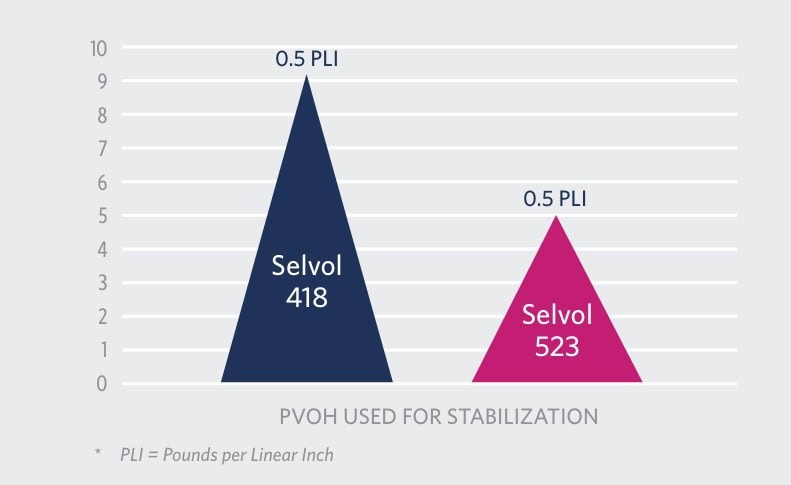
Selvol PVOH 418 retains higher adhesive strength than Selvol PVOH 523 after a 5-minute water soak, reflecting its higher hydrolysis level.
Compatibility With Post-Added PVOH
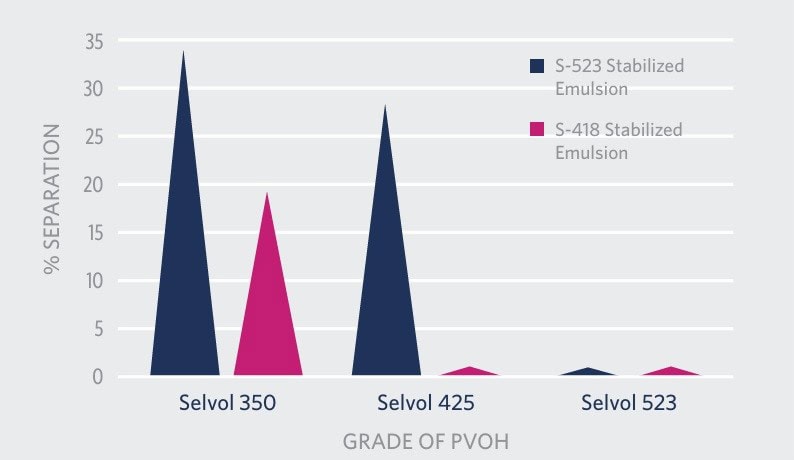
The compatibility test mixed each stabilized emulsion 50/50 by volume with a 10 wt% PVOH solution. Formulators then diluted the mixture to 1,000 cPs viscosity and stored it for 1 week at 70°C.
Lower percent separation indicates better compatibility. Selvol PVOH 418-stabilized emulsions showed significantly lower separation than Selvol PVOH 523-stabilized emulsions across all three post-added PVOH grades tested: Selvol 350, Selvol 425 and Selvol 523.
Typical Properties of Selvol PVOH 418
Selvol PVOH 418 balances the properties of fully and partially hydrolyzed Selvol PVOH.
| Property | Value |
|---|---|
| Hydrolysis level (%) | 91–93 |
| 4% solution viscosity (cPs) | 14–19 |
| pH | 4.5–7 |
| Volatiles, % max. | 5 |
| VOCs, % max. | 1 |
| Ash, % max. | 0.90 |
Polymerization Procedure With Selvol PVOH 418
The recommended polymerization procedure for Selvol 418 moves through four stages over 4 hours:
- Initial feed. Add PVOH at 5–10 wt% on total vinyl acetate monomer (VAM), along with sodium bicarbonate buffer and water.
- Initial heating. Bring the system to 50–55°C before beginning monomer and catalyst addition.
- Polymerization. Feed VAM and a redox catalyst (H₂O₂/sodium formaldehyde sulfoxylate) continuously at 70–74°C for approximately 2.5 hours.
- Post polymerization. Hold at 65–70°C after VAM and catalyst feeds are complete, bringing the total run time to 4 hours.
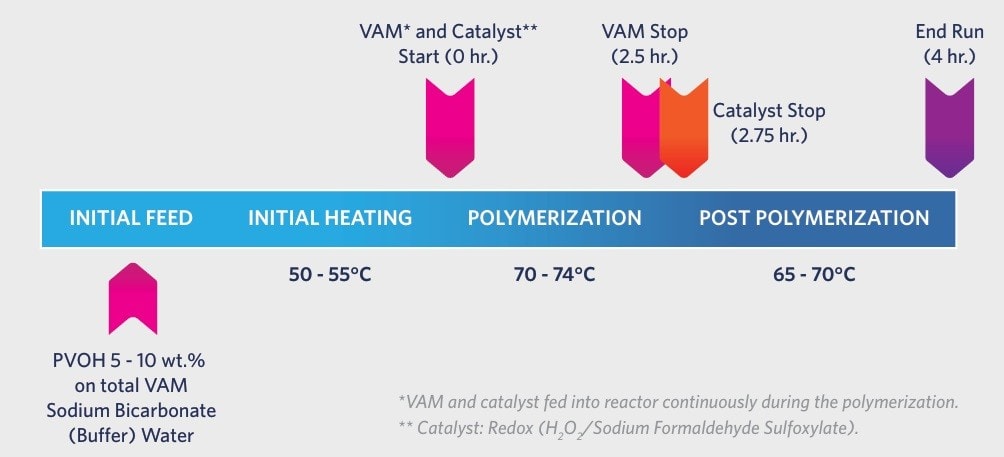
The four-stage polymerization procedure for Selvol PVOH 418, from initial feed through post polymerization, with temperature ranges and feed timing.
Resulting Emulsion Properties
The following emulsion properties result from this procedure using Selvol 418 at 6 wt% PVOH/VAM.
| Property | Value |
|---|---|
| % solids | 55 |
| pH | 5 |
| Free monomer (%) | < 0.5 |
| Viscosity (cPs) | 1,000 |
| Thickening ratio | 2.3 |
| Speed of set (sec) | 6-9 |
Contact SEKISUI for Selvol PVOH 418
SEKISUI engineered Selvol PVOH 418 expressly for emulsion polymerization. It offers a distinct combination of water resistance, formulation flexibility and post-addition compatibility that surpasses standard partially hydrolyzed grades.
Contact SEKISUI for more information about Selvol PVOH 418 or other Selvol PVOH grades, or request samples now.