Selvol™ Polyvinyl Alcohol Product Information
Manufacturers commonly use Selvol polyvinyl alcohol (PVOH/PVA) for adhesives. However, the industry and agriculture sectors also use it in emulsion polymerization, films and packaging, as well as in oil field cementing, paper, textiles, ceramics and seed coatings.
As a top PVOH supplier, SEKISUI Specialty Chemicals continually develops new applications for and products featuring PVOH.
Manufacturers make Selvol PVOH from vinyl acetate monomer (VAM) via a multistep process. They polymerize VAM into polyvinyl acetate and then convert it to PVOH.
Would you like more information? Read the full PDF brochure: Selvol PVOH, A Versatile, High-Performance Polymer.
Contact SEKISUI, request samples or speak with our expert Technical Services Team.
Selvol PVOH Grades
Selvol PVOH grades offer incredible versatility in one core product. In fact, it’s the most versatile PVOH product we offer. The key to working ideally with Selvol PVOH is finding the grade that suits your needs.
Standard Grades
Each Selvol PVOH grade varies in molecular weight and degree of hydrolysis.
We generally express molecular weight in terms of solution viscosity.
First, we classify the viscosities as ultra low, low, medium and high. We commonly denote the degree of hydrolysis as super, fully, intermediately and partially hydrolyzed. Additionally, we offer a wide range of standard grades.
In addition to SEKISUI Specialty Chemicals’ standard product line, we provide multiple specialty grades. These include polymerization, fine particle size and tackified PVOHs:
- Selvol PVOHs 805, 823 and 840 are improved versions of our standard polymerization grades (Selvol PVOHs 205, 523 and 540, respectively). These products offer many advantages in emulsion polymerization applications, including better water solubility and lower foaming.
- Selvol PVOH S-grades are similar to our standard grades. However, they have a fine particle size so that more than 99% of the product passes through a U.S.S. 80-mesh screen. These grades are available commercially as Selvol PVOHs 203S, 205S, 523S and 540S.
- Tackified Selvol PVOHs are products of the controlled boration of super-hydrolyzed and fully hydrolyzed grades. These borated alcohols yield viscous, aqueous solutions. These solutions also have a tailored degree of tack and significantly reduce penetration when applied to surfaces such as paper.
Selvol Polyvinyl Alcohol Solutions
At SEKISUI Specialty Chemicals, we provide pre-made solutions of some of our standard grades. A Selvol PVOH solution eliminates the dissolution step and creates distinct advantages:
- Ready-to-use, improved solution consistency
- Lower energy costs
- Lower processing costs (no cooking required)
Please note Selvol PVOH solutions are available in the U.S. only.
Selvol PVOH Typical Properties
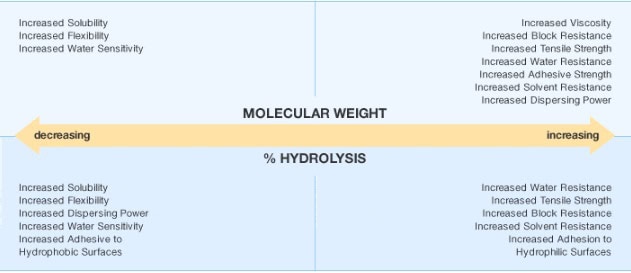
The degree of hydrolysis and molecular weight change how Selvol PVOH behaves.
Changes in PVOH Properties as the Degree of Hydrolysis and Molecular Weight Change
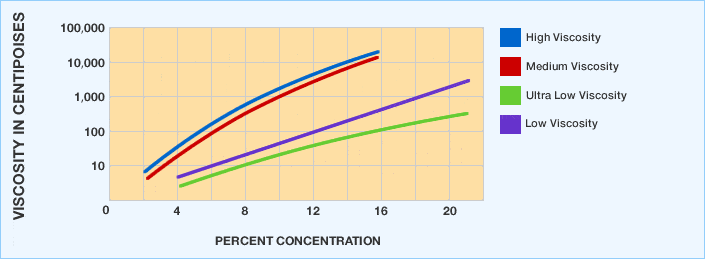
Viscosity/Concentration Relationships of Aqueous Selvol Polyvinyl Alcohol Solutions at 20%
Selvol Polyvinyl Alcohol Molecular Weight
| Viscosity | Viscosity Type | Degree of Polymerization | Average Molecular Weight Range |
|---|---|---|---|
| 3-4 cps | Ultra Low | 150-300 | 13,000-23,000 |
| 5-6 cps | Low | 350-650 | 31,000-50,000 |
| 22-30 cps | Medium | 1000-1500 | 85,000-124,000 |
| 45-72 cps | High | 1600-2200 | 146,000-186,000 |
Physical Properties
Selvol PVOH combines high tensile strength with ease of film formation. Additionally, Selvol PVOH resins show outstanding adhesive and bonding characteristics. Partially hydrolyzed grades adhere better to hydrophobic surfaces.
Furthermore, the degree of hydrolysis affects both the resin’s and the film’s water sensitivity. Water resistance increases as hydrolysis increases. You should use our super-hydrolyzed grades when you need maximum water resistance and humidity resistance.
Greases, petroleum hydrocarbons and animal or vegetable oils generally don’t affect Selvol PVOH resins. Resistance to organic solvents also increases alongside the degree of hydrolysis. When necessary, you can plasticize Selvol PVOH film with glycerol or lower molecular weight glycols. These substances usually act as humectants to hold water in the film.
Physical Properties of PVOH
| Appearance | White-to-cream granular powder |
| Bulk Density | 40 lbs per cu ft |
| Specific Gravity — of solid — of 10 wt % solid at 25°C | 1.27 – 1.311.02 |
| Thermal Stability | Gradual discoloration at about 100°C, rapid darkening above 150°C and rapid decomposition above 200°C |
| Thermal Conductivity, W/(m•K)3 | 0.2 |
| Electrical Resistivity, ohm•cm | (3.1 – 3.8) x 107 |
| Specific Heat, J/(g•K)b | 1.5 |
| Melting Point (unplasticized), °C | 230 for fully hydrolyzed grades and 180-190 for partially hydrolyzed grades |
| Tg, °C (dry film) | 75-85 |
| Storage Stability (solid) | Indefinite when protected from moisture |
| Flammability | Burns similarly to paper |
| Stability to Sunlight | Excellent |
Notes
- To convert W/(m•K) to (Btu•in)/(h•ft2•F), divide by 0.1441.
- To convert J to cal, divide by 4.184.
Chemical Reactions
PVOH resins react similarly to other secondary polyhydric alcohols. You can produce PVOH’s esterification reactions with a number of compounds. A commercially important reaction is the formation of tackified PVOH using boric acid or borax to form cyclic esters. This is a very pH-sensitive reaction, and an insoluble gel forms above 4.5-5.0.
Other esterification reactions include the following:
- Those with chloroformate esters to yield polyvinyl carbonate
- Those with urea to yield a polymeric carbamate ester
- Those with isocyanates to form substituted carbamate esters
Another commercially important reaction is acetalization with aldehydes. PVOH’s reaction with butyraldehyde produces polyvinyl butyral, which manufacturers use while producing interior adhesive film for safety glass. You can use its reaction with dialdehydes, such as glyoxal or gluteraldehyde, to crosslink PVOH.
Other reactions include ethoxylation, propoxylation and cyanoethylation.
Packaging and Storage
We offer Selvol PVOH products in several packages:
- Granular/powder product in 25 kilograms, 500 kilograms and 1,000 kilograms
- Solutions product in 450-pound drums and 2,250-pound totes
- Other packaging, as needed and available
Contact us for more information, request samples or reach our Technical Services Team.
Explore Selvol PVOH Technical Resources
Access specific grade data, preparation steps and formulation guidelines.
Applications and End Uses
Review the Selvol PVOH grade association matrix and typical uses across major industrial applications.
Product Line and Properties
Compare standard and specialty Selvol PVOH grades by viscosity, hydrolysis range and physical properties.
Solution Preparation
Access step-by-step guidelines, solution preparation tables and best practices for cooking Selvol PVOH.
Additives for Formulations
Explore recommended crosslinkers, defoamers, biocides and plasticizers for Selvol PVOH systems.
Selvol E PVOH and Product Line
Compare technical properties and regional sourcing advantages for our European-manufactured Selvol E PVOH grades.
Environmental, Health and Safety Information
Discover Selvol PVOH safety and handling, FDA and food contact, and right-to-know information.
Products